NurseAid
SCOPE
SCOPE
UX / HCI · Critical-alert workflow
UX / HCI · Critical-alert workflow
CONTEXT
CONTEXT
Canadian inpatient + ICU nursing
Canadian inpatient + ICU nursing
STATUS
STATUS
Concept prototype · Validation pending
Concept prototype · Validation pending
Designing for the moment attention shifts.
Designing for the moment attention shifts.
NurseAid is a nurse-first mobile dashboard concept exploring how Canadian inpatient and ICU nurses might review and mark time-sensitive information as seen while managing interruptions.
NurseAid is a nurse-first mobile dashboard concept exploring how Canadian inpatient and ICU nurses might review and mark time-sensitive information as seen while managing interruptions.


Evidence boundary: This is an evidence-informed design exploration—not a clinically validated or production-ready product.
Evidence boundary: This is an evidence-informed design exploration—not a clinically validated or production-ready product.
THE QUESTION BEHIND NURSEAID
How can nurses know what needs attention next when information is fragmented and work is interrupted?
How can nurses know what needs attention next when information is fragmented and work is interrupted?
01 · Frame
The problem is not always missing information.
The problem is not always missing information.
The challenge may be locating, interpreting and acting on the right information across fragmented systems while attention is repeatedly interrupted.
The challenge may be locating, interpreting and acting on the right information across fragmented systems while attention is repeatedly interrupted.

02 · Evidence boundary
Early observations shaped the questions.
Early observations shaped the questions.
The project began with personal observations, informal conversations with nurse friends and secondary research. These inputs informed the initial problem framing and prototype scope.
The project began with personal observations, informal conversations with nurse friends and secondary research. These inputs informed the initial problem framing and prototype scope.
They are exploratory inputs, rather than formal interview findings or validated user requirements. The next step is moderated testing to examine whether the design assumptions hold in practice.
They are exploratory inputs, rather than formal interview findings or validated user requirements. The next step is moderated testing to examine whether the design assumptions hold in practice.
The scope stays deliberately narrow
NurseAid is a concept prototype. It does not diagnose, recommend treatment or replace an EHR. Marking an alert as seen does not establish follow-up ownership, escalation or clinical resolution.
NurseAid is a concept prototype. It does not diagnose, recommend treatment or replace an EHR. Marking an alert as seen does not establish follow-up ownership, escalation or clinical resolution.
What remains open.
What remains open.
Which information belongs above the fold?
Which alerts should appear in NurseAid?
What does “seen” mean operationally, and how is follow-up responsibility established?
Which source is authoritative?
Would mobile access reduce searching or introduce another system?
Would nurses adopt this workflow?
Which information belongs above the fold?
Which alerts should appear in NurseAid?
What does “seen” mean operationally, and how is follow-up responsibility established?
Which source is authoritative?
Would mobile access reduce searching or introduce another system?
Would nurses adopt this workflow?
03 · Approach
Broad exploration, deliberate narrowing.
Broad exploration, deliberate narrowing.
I treated the work as an HCI investigation: make assumptions visible, map risk to interface behaviour and reduce a broad product vision to a workflow that could be tested credibly.
I treated the work as an HCI investigation: make assumptions visible, map risk to interface behaviour and reduce a broad product vision to a workflow that could be tested credibly.

How I work
Four disciplines, one design position.
Four disciplines, one design position.
The project demonstrates a practice focused on healthcare problems, responsible technology and observable human behaviour.
The project demonstrates a practice focused on healthcare problems, responsible technology and observable human behaviour.
Healthcare UX
I designed around patient identity, access boundaries, data provenance and interruption—not generic consumer-app conventions.
I designed around patient identity, access boundaries, data provenance and interruption—not generic consumer-app conventions.
HCI research
I converted uncertainties into research questions, test scenarios and behaviours to observe.
I converted uncertainties into research questions, test scenarios and behaviours to observe.
AI + emerging technology
I explored integration and future intelligence while explicitly excluding autonomous diagnosis or treatment recommendations.
I explored integration and future intelligence while explicitly excluding autonomous diagnosis or treatment recommendations.
Accessibility and inclusion
I considered fatigue, movement, one-handed use, assistive technology, colour vision and text enlargement as core conditions.
I considered fatigue, movement, one-handed use, assistive technology, colour vision and text enlargement as core conditions.
04 · Provisional user
Nina represents a context, not an invented biography.
Nina represents a context, not an invented biography.
The persona intentionally excludes age, salary, family, personality labels and fabricated quotes. It concentrates on demands that affect interface use and still require validation with practising nurses.
The persona intentionally excludes age, salary, family, personality labels and fabricated quotes. It concentrates on demands that affect interface use and still require validation with practising nurses.

05 · Product strategy
Minimum necessary information, not another EHR.
Minimum necessary information, not another EHR.
NurseAid’s proposed role is deliberately narrow: provide a focused view of assigned patients and alerts while keeping the authoritative clinical record elsewhere.
NurseAid’s proposed role is deliberately narrow: provide a focused view of assigned patients and alerts while keeping the authoritative clinical record elsewhere.
Always visible
Patient identity, room and bed, second identifier, severity, status, reason, source, timestamp, freshness and must-not-miss information.
Always visible
Patient identity, room and bed, second identifier, severity, status, reason, source, timestamp, freshness and must-not-miss information.
One tap away
Relevant observations, a small trend, medication timing, alert history, ownership and source-system access.
One tap away
Relevant observations, a small trend, medication timing, alert history, ownership and source-system access.
Excluded
Full chart, documentation history, unrelated results, complete care plan and clinical decision recommendations.
Excluded
Full chart, documentation history, unrelated results, complete care plan and clinical decision recommendations.
MVP decision
Safe critical-alert review
Secure sign-in and reauthentication
Secure sign-in and reauthentication
Assigned patients and focused snapshot
Assigned patients and focused snapshot
Alerts inbox and alert detail
Alerts inbox and alert detail
Patient confirmation
Patient confirmation
Mark-as-seen action with explicit audit state
Mark-as-seen action with explicit audit state
Recovery from interruption and failure
Recovery from interruption and failure

06 · Core interaction
A short happy path with visible safety checks.
A short happy path with visible safety checks.
The selected direction combines alert detail and focused context where possible, reducing navigation while preserving explicit identity, freshness and mark-as-seen checkpoints.
The selected direction combines alert detail and focused context where possible, reducing navigation while preserving explicit identity, freshness and mark-as-seen checkpoints.

07 · Safety by interface
Failure states are part of the product.
Failure states are part of the product.
I treated recovery as a primary design surface. Each state communicates uncertainty, constrains unsafe interpretation and provides a path forward without inventing hospital procedure.
I treated recovery as a primary design surface. Each state communicates uncertainty, constrains unsafe interpretation and provides a path forward without inventing hospital procedure.
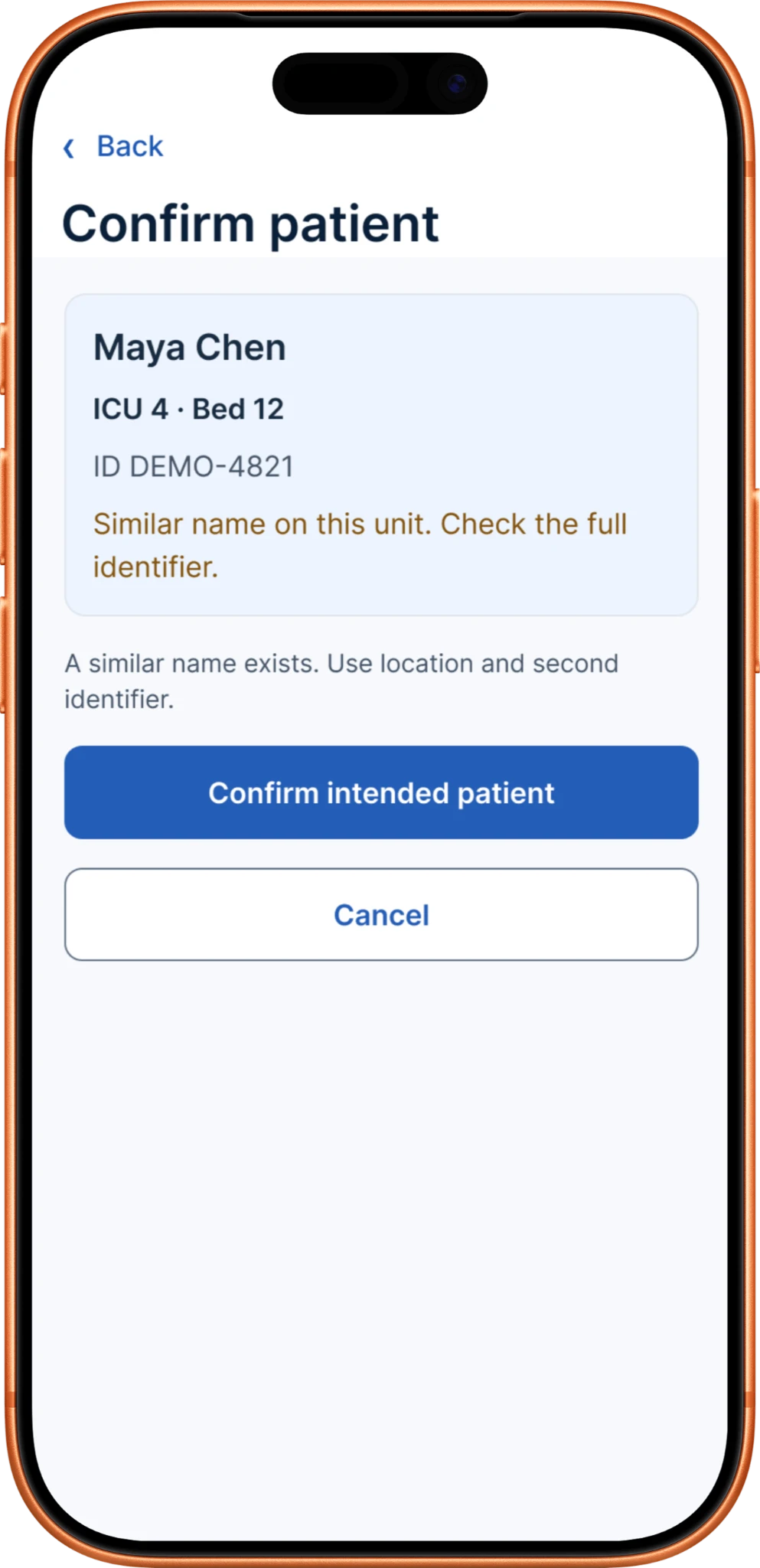
Identity
Duplicate patient names
Require full name, location and a second identifier; never rely on name alone.
Require full name, location and a second identifier; never rely on name alone.
Freshness
Stale or delayed data
Show the last confirmed update and never imply that unavailable information is current.
Show the last confirmed update and never imply that unavailable information is current.

Connectivity
Offline recovery
Preserve safe context, offer retry and recheck freshness after reconnection.
Preserve safe context, offer retry and recheck freshness after reconnection.

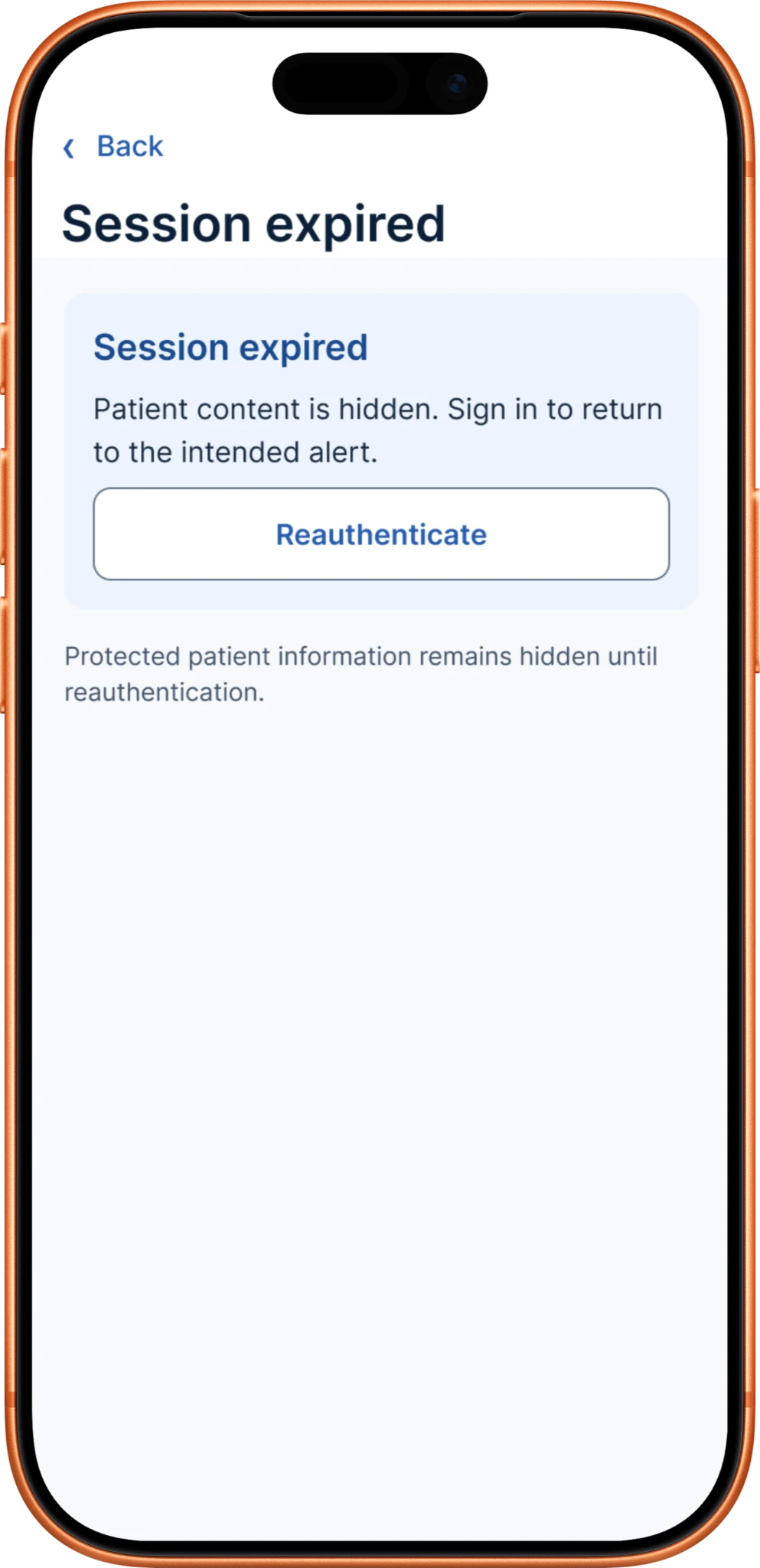
Access
Expired or denied sessions
Hide protected content, reauthenticate when appropriate and return to the intended context.
Hide protected content, reauthenticate when appropriate and return to the intended context.
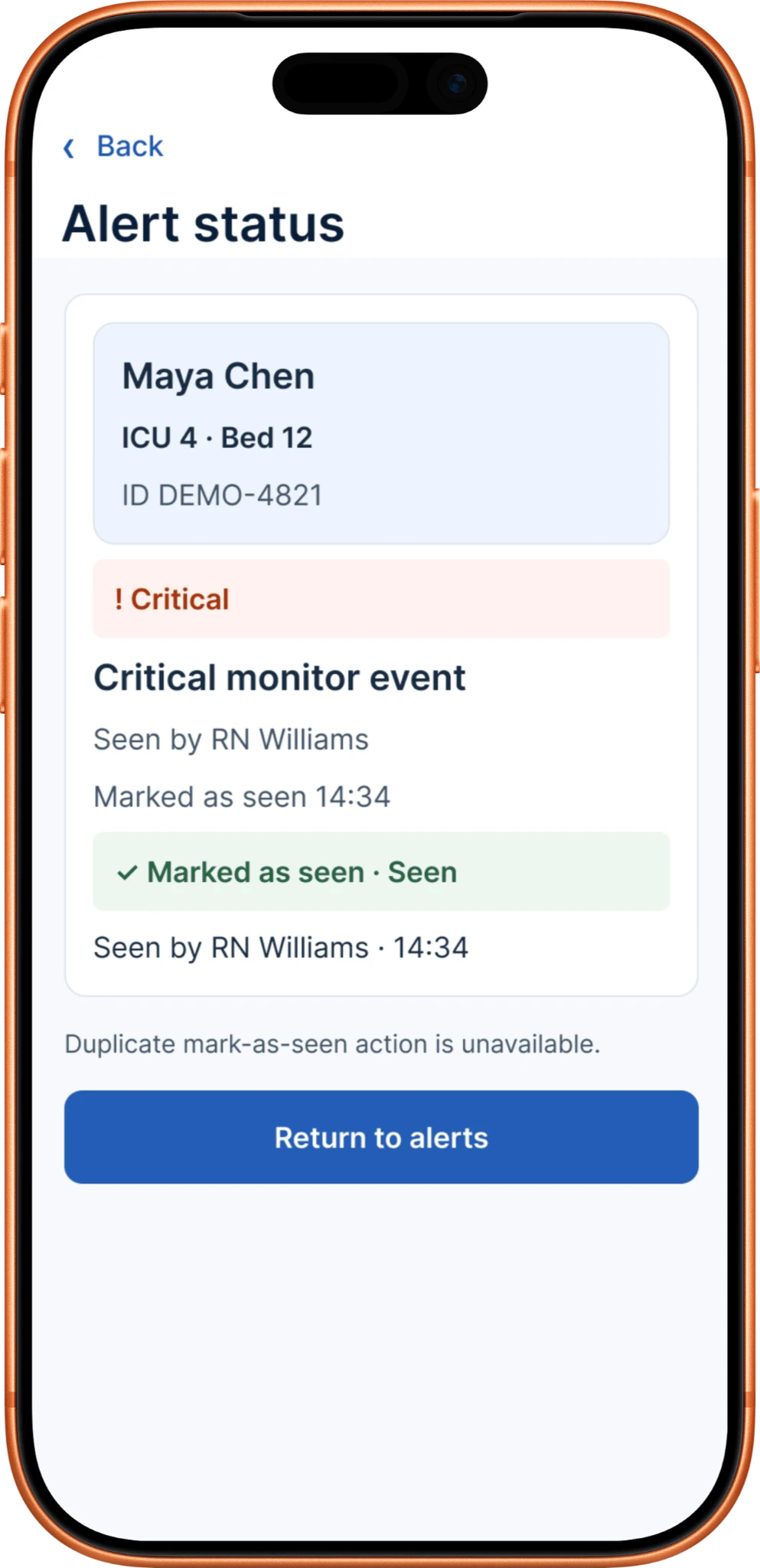
Status
Already marked as seen
Show actor and time, prevent duplication and state whether follow-up has an owner.
Show actor and time, prevent duplication and state whether follow-up has an owner.
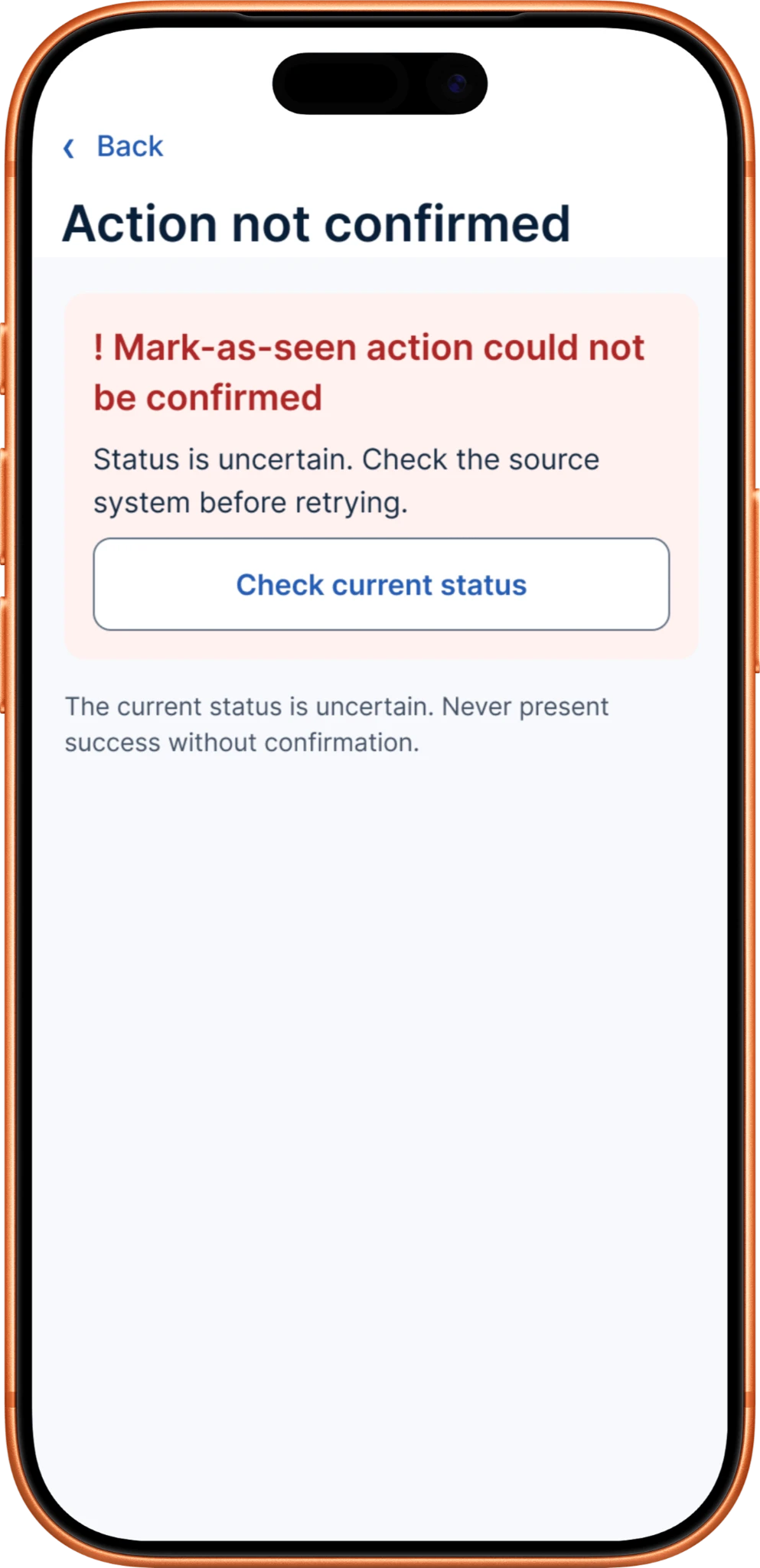
Feedback
Seen status not confirmed
Never show success without confirmation; communicate uncertain status and recovery options.
Never show success without confirmation; communicate uncertain status and recovery options.
Explore additional safety and recovery scenarios in the interactive prototype.
Explore additional safety and recovery scenarios in the interactive prototype.
07B / PRACTITIONER-INFORMED ITERATION
07B / PRACTITIONER-INFORMED ITERATION
Seeing an alert is not the same as taking responsibility.
Seeing an alert is not the same as taking responsibility.
An informal conversation with a practising nurse exposed a second safety layer: the original acknowledgment model did not explain ownership, escalation or clinical follow-through. This directional feedback is not representative research.
An informal conversation with a practising nurse exposed a second safety layer: the original acknowledgment model did not explain ownership, escalation or clinical follow-through. This directional feedback is not representative research.
Design response: separate Seen, Follow-up owner, Escalation and Resolution instead of compressing them into one status.
Design response: separate Seen, Follow-up owner, Escalation and Resolution instead of compressing them into one status.
Questions the feedback opened.
Questions the feedback opened.
INFORMAL DISCOVERY / Who is responding?
An alert may be seen without anyone explicitly accepting responsibility for follow-up.
CLINICAL QUESTION / Which target applies?
Patient-specific targets must come from a verified authoritative source, never from NurseAid inference.
OPERATIONAL QUESTION / Who carries the device?
A managed per-shift device pool is the provisional model; loss, charging and handover require validation.
PROVISIONAL ALERT RESPONSIBILITY STATES
PROVISIONAL ALERT RESPONSIBILITY STATES
01 / New
02 / Seen
03 / Accepted or escalated
04 / Action documented in source record
05 / Resolved by authorized workflow
01 / New
02 / Seen
03 / Accepted or escalated
04 / Action documented in source record
05 / Resolved by authorized workflow
Provisional model: Terminology, permissions and escalation rules require validation with nurses, clinical informatics and hospital leadership.
Provisional model: Terminology, permissions and escalation rules require validation with nurses, clinical informatics and hospital leadership.
08 · Reusable foundations
A dependable visual language for clinical attention.
A dependable visual language for clinical attention.
The system balances clinical restraint, precision and modern mobile interaction. Components carry semantic status through language, shape and hierarchy—not colour alone.
The system balances clinical restraint, precision and modern mobile interaction. Components carry semantic status through language, shape and hierarchy—not colour alone.

Current validation status
Current validation status
The prototype is ready for early comprehension, navigation and recovery testing. Informal practitioner feedback has informed a provisional responsibility model; formal practising-nurse research and clinical stakeholder review remain future work.
The prototype is ready for early comprehension, navigation and recovery testing. Informal practitioner feedback has informed a provisional responsibility model; formal practising-nurse research and clinical stakeholder review remain future work.
Test core safety separately from provisional responsibility concepts.
Test core safety separately from provisional responsibility concepts.
A researcher-only launcher injects simulated conditions at relevant moments. These controls remain outside the proposed NurseAid navigation and participant-facing UI.
A researcher-only launcher injects simulated conditions at relevant moments. These controls remain outside the proposed NurseAid navigation and participant-facing UI.
Core MVP safety tests
Core MVP safety tests
Identity and access
Duplicate names, permission denial and session expiration.
Data trust
Stale data, delayed synchronization and missing source information.
Connectivity
Offline recovery without presenting cached information as current.
Seen-status reliability
Already seen and confirmation-failure states remain visibly distinct.
Empty states
No assigned patients and no active alerts are separated from load failure.
Exploratory responsibility tests
Exploratory responsibility tests
PROVISIONAL CONCEPTS
Seen but unowned
Does the nurse recognize that no one has accepted follow-up?
Escalation pending
Is attempted escalation distinguishable from confirmed receipt?
Target unavailable
Does the interface avoid implying a generic clinical target?
Lost managed device
Can the workflow protect PHI and support safe continuation elsewhere?
What early testing can evaluate
Recognition of patient identity
Recognition of patient identity
Understanding of source, timestamp and freshness
Understanding of source, timestamp and freshness
Meaning assigned to seen status and follow-up responsibility
Meaning assigned to seen status and follow-up responsibility
Recovery choices after failures
Recovery choices after failures
Expected destination after resuming work
Expected destination after resuming work
Evidence boundary: These scenarios evaluate comprehension, navigation and expectations. They cannot validate clinical policy, legal protection or patient outcomes.
Evidence boundary: These scenarios evaluate comprehension, navigation and expectations. They cannot validate clinical policy, legal protection or patient outcomes.

Select a simulated scenario to explore the prototype’s safety and recovery flows
Select a simulated scenario to explore the prototype’s safety and recovery flows
10 · Responsible Technology
Emerging technology needs boundaries before ambition.
Emerging technology needs boundaries before ambition.
NurseAid anticipates interoperability and future intelligence, but the MVP keeps clinical information read-only and simulates only a mark-as-seen action.
CURRENT PROTOTYPE / Human-readable consolidation
Focused context, provenance, freshness and status—without diagnosis or treatment advice.
FUTURE OPPORTUNITY / Assisted prioritization
Summaries, pattern detection and predictive support remain speculative and outside this prototype.
BOUNDARY / No autonomous clinical recommendations
AI must not diagnose, prescribe or imply that seeing an alert resolves a clinical situation.
11 · Reflection
The product became smaller as the thinking became stronger.
The product became smaller as the thinking became stronger.
The most consequential decision was not adding a feature. It was narrowing the concept to a workflow where identity, freshness, status and resumption could be examined honestly.
The most consequential decision was not adding a feature. It was narrowing the concept to a workflow where identity, freshness, status and resumption could be examined honestly.
NurseAid is not an attempt to redesign the healthcare system. It is a focused exploration of how nurses might review and mark time-sensitive information as seen more clearly while managing interruptions.
NurseAid is not an attempt to redesign the healthcare system. It is a focused exploration of how nurses might review and mark time-sensitive information as seen more clearly while managing interruptions.
Sandra Osaretin / Design reflection
Sandra Osaretin / Design reflection
What changed
A broad dashboard vision became a focused, testable alert workflow with explicit recovery states.
A broad dashboard vision became a focused, testable alert workflow with explicit recovery states.
What I learned
Clinical credibility depends as much on uncertainty, provenance and failure handling as on the happy path.
Clinical credibility depends as much on uncertainty, provenance and failure handling as on the happy path.
What comes next
Moderated sessions, clinical-language review, accessibility stress testing and validation of operational policies.
Moderated sessions, clinical-language review, accessibility stress testing and validation of operational policies.
12 · Next research
Questions worth carrying forward.
Questions worth carrying forward.
The next phase should test the concept with practising nurses and hospital stakeholders before making claims about fit, safety or outcomes.
The next phase should test the concept with practising nurses and hospital stakeholders before making claims about fit, safety or outcomes.
Nurse validation
Which alerts genuinely belong?
Which alerts genuinely belong?
What information is needed above the fold?
What information is needed above the fold?
Does mobile access fit real work?
Does mobile access fit real work?
How should interrupted work resume?
How should interrupted work resume?
System validation
Which source is authoritative?
Which source is authoritative?
How is seeing an alert distinguished from follow-up responsibility locally?
How is seeing an alert distinguished from follow-up responsibility locally?
When can stale data block action?
When can stale data block action?
What escalation path is approved?
What escalation path is approved?
NurseAid
NurseAid
An evidence-informed exploration at the intersection of healthcare UX, HCI research, emerging technology and accessible interaction design.
An evidence-informed exploration at the intersection of healthcare UX, HCI research, emerging technology and accessible interaction design.
All patient names and data shown are fictional. No clinical efficacy or compliance claim is made.
All patient names and data shown are fictional. No clinical efficacy or compliance claim is made.